
Amour
Capsule Film Review #11

This is the eleventh in a series of short pieces (max. 250 words) about films. They appear weekly, in addition to my regular essays.
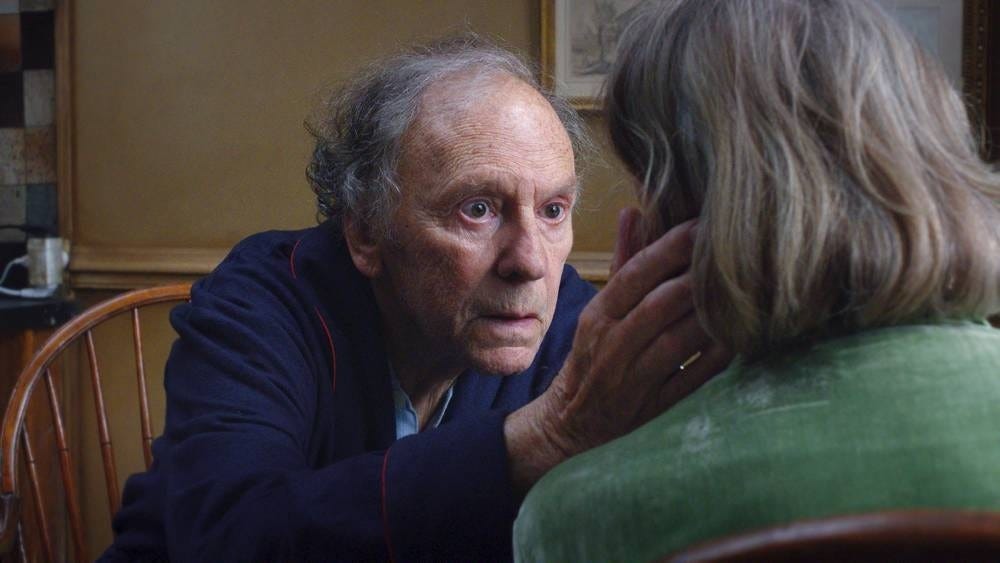
I have never written here about any film that I have not seen half a dozen times, minimum: even (perhaps especially) when I don’t seem to like it much. At least, not until now.
The critic Anthony Lane once unhesitatingly (and correctly) declared Sansho the Bailiff to be a masterpiece, but then confessed to having seen it only once:
I have not dared watch it again… the human heart was not designed to weather such an ordeal.
I feel the same about Amour (2012, d. Michael Haneke).
I thought I knew Haneke’s tricks. Amour would be a Brechtian provocation, filled with icy violence, avant-garde games, and what passes for philosophy in Parisian art galleries. Its title (I was sure) would be as cruel as the title of Funny Games.
Yet here are no tricks. Not ‘realism’ exactly (the film’s seemingly unreal scenes are just as real as the others), but only ‘reality’.
Georges Laurent takes care of his elderly, paralysed wife Anne: listening to her grunts; half-longing for her death; wiping away the tears from her eyes and the dribble from her mouth; wheeling her back and forth from the bathroom and away from the open window. It seems so grim and so thankless; for young people, with our greedier expectations of life, it seems so hopeless.
Anne is not going to get better. She knows it. Georges knows it. We know it. Yet we never ask why he is doing this, and nor does he. Look at the title.
Sansho the Bailiff is, unmistakably, a masterpiece. Its images—shot by Kazuo Miyagawa—carry a severity and grace that define Mizoguchi’s cinema. Miyagawa collaborated only once with Yasujiro Ozu, on Floating Weeds, and the difference is immediately visible. The film stands apart from Ozu’s usual visual grammar, shaped as it was not by Yūharu Atsuta—Ozu’s lifelong cinematographer—but by a sensibility formed elsewhere. The contrast makes clear how central Atsuta’s eye was to what we now recognize as “Ozu.”
cf. gaspar noe's Vortex