
Halloween
Capsule Film Review #6

This is the sixth in a series of short pieces (max. 250 words) about films. They appear in addition to my regular essays.
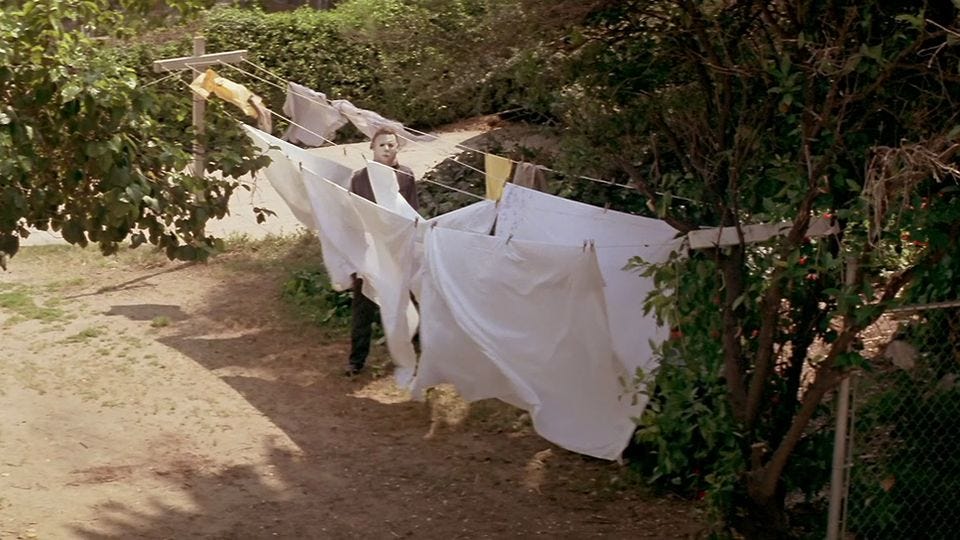
In a sense, the slasher movie has the least potential of any film or TV genre. Unusually restricted and rule-governed even by the standards of cheap popular cinema, the slasher seems to be composed entirely of clichés—clichés which, as is not the case with (say) Casablanca, do not add up to much.
In another sense, however, the slasher movie teems with sinister potential. No other genre, not even melodrama, not even porn, is more fundamentally reactionary. Slasher movies are so reactionary, in fact, as to be disturbing—which, given that they are horror movies, is not much of a criticism.
So: a mysterious, masked, impossibly stealthy, blade-wielding murderer, who may or may not be a human being and who may or may not be avenging some past slight, exacts sadistic punishments on groups of young men and (especially) women for the symbolic crimes of drinking and having sex. The woman who does neither of those things is the one who survives.
Halloween (1978, d. John Carpenter) did not exactly invent that premise, but remains the best example: so many aspects of the film, from the ultra-simplistic score to Donald Pleasence’s mad bluster to Michael Myers panting like a dog out of water, are still thoroughly creepy, even now.
Carpenter, who is a figure of the Hollywood Left, did not intend to unleash the dark psychic forces which people on the Hollywood Left like to imagine belong to the past. But unleash them he did. The jungle grows back.