
No Surprises
On getting used to things and not getting used to things

One
In three words I can sum up everything I’ve learned about life. It goes on.
That—allegedly at any rate—is a remark made by Robert Frost, a great poet who spent a considerable portion of his public life making fortune-cookie-style pronouncements of that sort, and who might even have made one. The remark, if its popularity in anthologies and on social media is anything to go by, has been edifying and uplifting for many people, though for me it is—I fear, possibly for that reason—thoroughly irritating.
Perhaps the only certainty that we have about this life, after all, is that it does not go on; for every courageous person who repeats that line to help themselves cope with their own difficulties, there will be another who repeats it in order to disregard someone else’s; and anyway, in all too many cases, we know that the same sort of person who will tell you that Life Goes On will also tell you that This Too Shall Pass, though they would seem to be contradicting themselves.
That is pedantry, obviously. Life Goes On and This Too Shall Pass: there is clearly a sense in which each of those sentiments is true. Human beings are resilient creatures, and, both through our own sufferings and through those of others, we are able a lot of the time to just get on with things: with the ordinary stuff of life, the buttoning and the unbuttoning, what Cesare Pavese calls il mestiere di vivere, the business of living. And, in spite of it all, that business goes on: in spite of the drought and the rains; in spite of the invasions and the armadas; in spite of the state-sanctioned murders.
Two
The other day, in the Substack notes, Junot Díaz quoted the following line from Kafka’s diary, the entry for 2nd August, 1914:
Germany has declared war on Russia. Swimming in the afternoon.
‘Every day I watch the terror grow,’ Díaz added, ‘and every day I have to work.’ When I read that, I immediately thought of Cultural Amnesia, Clive James’s beautiful and deeply strange collection of personal essays, and in particular of its entry on Thomas Mann, whose diary, according to James, is testimony to Mann’s capacity to get on with life, in spite of it all.
In April 1941, with a rampant Hitler already on the point of turning east, Mann’s idea of a pertinent note in his diary was: Der Pudel gesund. The poodle is healthy. He wasn’t talking in code. He meant the family dog.
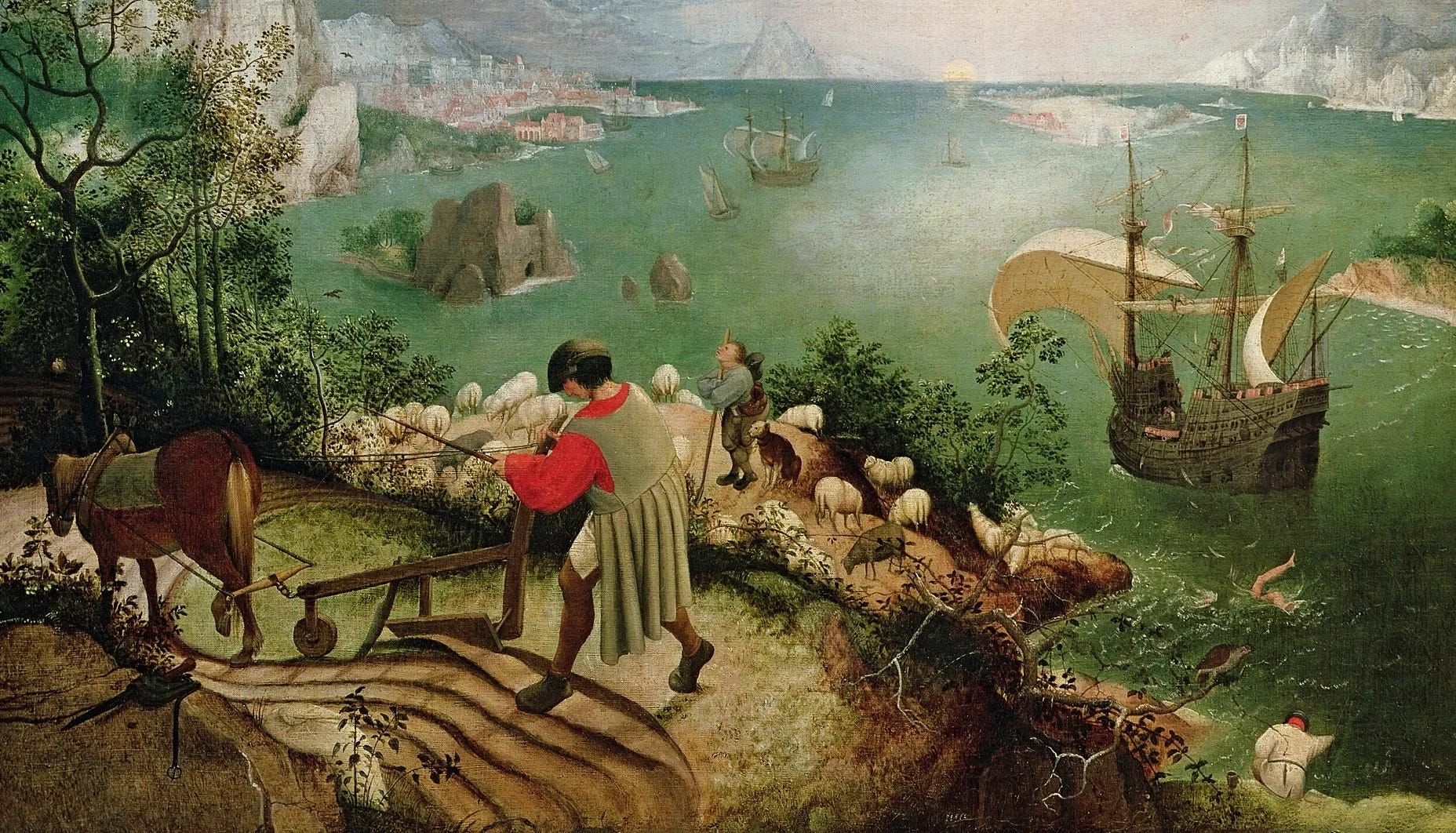
The three thoughts here seem to be the same thought: swimming in the afternoon, and every day I have to work, and der Pudel gesund—three different instances of what some people mean when they say that Life Goes On. Another one—of which I was promptly reminded in a comment on my comment on the comment—is Auden’s ‘Musée des Beaux Arts’, his great poem purportedly inspired by the painting at the top of this page.
In Brueghel’s Icarus, for instance: how everything turns away
Quite leisurely from the disaster…
Icarus was, of course, the son of Daedalus, the master craftsman who fashioned wings for the boy to allow him to escape from the labyrinth of King Minos. Notwithstanding his father’s warnings, Icarus flew close to the sun, and, when he did, the wings melted and he plunged to his death in the sea.
All that can be seen of Icarus in the painting (and in the poem) are his legs, ‘disappearing into the green water’: just a background detail, apparently. Icarus drowns, but, on the hillside and in the sea and in the distant port city, Life Goes On. A ploughman goes on plodding, a dog goes on with its ‘doggy life’—
…and the expensive delicate ship that must have seen
Something amazing, a boy falling out of the sky,
Had somewhere to get to and sailed calmly on.
Three
About suffering we are seldom right, we human beings, and thank goodness: if we always were, it is doubtful any of us would be able to live at all. Beyond any doubt, at the very moment that you are reading these words, somebody is drowning, and, though some of the more eccentric of the world’s thinkers would have you believe that you must therefore stop what you’re doing right now and act, in all likelihood you are not going to.
For thousands of years it has been almost a truism—or, at least, a frequently repeated truth—that philosophy has its origin in a sense of wonder, and that that wonder begins with the astonishing fact, so easily ignored by most of us most of the time, that anything exists at all. Equally, or so it seems to me, it is almost a truism that, if everyone was a philosopher, and felt that way all the time, society would fall apart. We cannot hold on, always, to the sense of wonder, and, in the same way, we cannot hold on, always, to the parallel sense of horror: the reality of suffering, its omnipresence, the myriad unmitigated tortures taking place at every moment of every day: the animals, human or otherwise, who are tearing each other to pieces alive right now; the men, women, and children being raped and tortured and murdered right now; or a child, right now, who has just fallen into the sea.
We know that we cannot spend all day every day thinking about this, for the same reason that we cannot spend all day every day asking why there is something rather than nothing, or whether or not life is worth living. The horror, like the wonder, hits us only sometimes, and, in both cases, there will always be some people who say that the primal feelings involved are ‘childish’ or ‘naïve’, and perhaps they are right. Those people may even, if they happen to be employed in philosophy departments, say that those two great questions just don’t make sense. It is easy (and also enjoyable) to make fun of such people, but they are clearly right in at least one way. Practically speaking, if nothing else, life goes on.
Four
Martin Amis, in his last collection of non-fiction, The Rub of Time (2017), reaches the following conclusion at one point in one of the essays:
To say this of human beings is to say both the best and the worst. They can get used to anything.
My italics: that simple observation, like those about the wonder and the horror, is so often repeated as to seem almost banal. I find it, for example, in the writing of one of my heroes, Anthony Burgess—
We become habituated to anything.
—just as I find it in perhaps the greatest novel of the 19th century, Anna Karenina:
There are no conditions to which a man cannot become used…
And I also find it, as presumably most people do, in my own life, shouted at me over and over again by experiences both good and bad. People get used to anything: perhaps there is no more terrifying fact.
A few years before he wrote that diary entry about his poodle, Thomas Mann wrote another one containing a pronouncement about (or against) the political responsibilities of the artist—the pronouncement which provoked one part of James’s essay about him.
Abwenden! Abwenden!
Turn aside! Turn aside!
‘He felt it; he believed it,’ James writes, ‘but luckily he did otherwise.’ Mann wrote that in the late thirties, at which time Germany had ceased to be any kind of tolerant society, and at which time, therefore, it was starting to seem inappropriate for any German to say things like that. Some people would say it is always inappropriate to say things like that—and some of them are even sincere. They feel it; they believe it; but most of the time they, too, do otherwise.
Perhaps a working definition of a tolerant society might be that it is one which allows its people to be apolitical: to get used to things, to get on with the business of living, to turn aside from the world of affairs and worry about more important things like Love and Death. And there is probably something to be said for that: believing in nothing, though not usually a very attractive prospect for the individual soul, is seldom as dangerous for society as people seem to think. (After all, just look at the people who believe in something …) My grandmother, who was born in 1930 and who spent more or less her entire adult life serenely indifferent to the problems of the world, was very privileged in many ways, though also (starting with the fact that she was a war orphan) unprivileged. She got used to the good and to the bad. She told me more than once that she believed in absolutely nothing and, though it is tempting to say that she did not hurt anyone by feeling that way, and by just getting on with her life, we know—don’t we?—that it is not that simple.
Five
‘Civilisation advances,’ wrote Alfred North Whitehead, ‘by extending the number of important operations we can perform without thinking about them’: and among these operations, obviously, are acts and instances of great suffering. Civilisations are built on indifference to suffering, and being able, at least to some extent, to turn aside from the suffering of others (and indeed from our own, insofar as we can) is a condition of sanity—our own and society’s.
People get used to anything: as Amis says, that is the best and the worst of us. Just look, for example, at the people you know who are suffering the most, how resilient they can be, how stubbornly courageous… I know more than a few people who have gone through (or are currently going through) chemotherapy, and I’ve heard from some of them this same observation: that an experience which is overwhelming the first time that it happens becomes, by the umpteenth time, something very close to boring, once you’ve got used to it.
The same thing, probably, can be said for the horrors of old age: people get used to that, too—or so it seems to me, anyway, at the age of thirty-five. Philip Larkin was older than I am now, though still not very old, when he wrote his terrifying poem ‘The Old Fools’, collected in his fourth collection of poetry, High Windows (1974):
What do they think has happened, the old fools,
To make them like this?
In that poem, the speaker’s own fear of suffering and dying is transmogrified into rage and disgust at the elderly: drooling and pissing themselves, giving off that ‘air of baffled absence’, trying to remain in the past and yet locked in the ‘hideous, inverted childhood’ of the present. Can they not see it? the speaker wonders to himself:
Why aren’t they screaming?
Six
Larkin’s question is a version of the same question that some people ask when they are outraged by world events and wish to implore others to do something: the kind, in other words, that we ask in those moments when we are no longer used to reality. It is also, therefore, the kind of question we don’t ask all that often. Most of the time, after all, we aren’t screaming, no matter what is happening to us. One of my aunts worked for many years at an old age home (the same one where, in 2020, my grandmother eventually died) and that home was, she tells me, far more often full of laughter and silence and dull despair than it ever was with screams. Evidently the only answer to Larkin’s question (if it requires an answer) is habituation. People get used to anything, and the old fools have got used to this.
Again, this is the best and the worst. Both the good and the bad can be seen in another context, and one which is, sometimes, eerily similar to the trials of old age. People who suffer from drug and alcohol addiction get used to any number of things that would horrify those who do not. And that is for the best—since it is a kind of self-protection, a way of no longer being shocked by the shocking—and it is for the worst—since it is also a kind of self-destructive indifference, a way of not dealing with the problem. As in the political sphere, one way lies (relative) sanity; the other way, quietism and indifference. Sometimes we can choose to get used to things.
It is completely natural, for example, for people to be disgusted at the sight of vomit, including their own. Spend a few years vomiting every other day, however… well, that feeling won’t last, or at least not in the same way. You cannot go on being traumatised by the same repeated event day after day, any more than Miss Lonelyhearts, in Nathanael West’s great novel, can go on finding the same joke funny. And—just as with the old fools seen by the young—it can be hard for people with no personal experience of addiction to imagine what such habituation is like: to have reached the stage where, for example, waking up in a hospital with no knowledge of how you got there has become simply boring.
It had already become boring to me by the time I was nineteen (so much so that I didn’t stop doing it for another ten years), and it was around that age, give or take a year or two, that I wrote the following piece of doggerel in response to Larkin:
Ah, Philip. I suppose that I should laugh,
reciting your thin last volume in the bath
to realise drunks are really like the old:
lonely, baffled-absent, death-drawn, cold,
pissing ourselves and drooling (and the rest),
remembering intermittently at best.
The peak that stays in view, I tend to think,
rises so much more quickly when you drink.
I called that doggerel (O woe is me!) ‘The Young Fool’, but now I think I should have called it ‘Ode to Habituation’—the worst but also the best.
‘The peak that stays in view’—in my doggerel and in Larkin’s poem—is of course Death, and that, too, is something to get used to, just like the wonder and the horror, and just like the state-sanctioned murders. Even the terminally ill can, at least momentarily, get used to what they go through, and so can we, who are terminally ill in another sense.
It may be that what John von Neumann once said about the truths of mathematics—that one does not understand them, but only gets used to them—we could say for all the facts of life and society. What else is there but to get used to it? Something exists; millions are suffering at this very moment; dictators are dictating; what I think I think alone; none of us is free; there is no escape from the Cartesian daemon; I will die, I will die, I will die…
Seven
One common word for all of this is desensitisation, and desensitisation is a species of habituation, of getting used to things. Martin Amis’s remark comes from an essay about Cali, Colombia, and the innumerable sufferings visited upon that city by the cartel which takes its name. Whether or not ordinary Colombians got used to such things is not for me to say, but without a doubt the world got used to thinking of Colombia in that way—as the land of kidnappings and narcoterrorism—just as the world has long since got used to thinking of other places in rather similar ways: certain bad stuff just happens there, and there’s nothing to be done about it. Ukraine, Gaza, Iran, Venezuela, the United States… People are dying! shouts one voice. People are always dying, responds another.
Desensitisation is also, of course, one of the subjects of Anthony Burgess’s most famous novel (and of Stanley Kubrick’s film adaptation of it). The remark of Burgess’s that I quoted above, however, comes not from that novel but from one of his autobiographies, Little Wilson and Big God, in the context of the basic training he underwent as a soldier. On balance, Burgess would probably have preferred not to have gone through desensitisation of this sort, and neither, presumably, would those people who are dying in the troubled countries. For those of us slightly more comfortable, watching them, as the cigarettes pile up in the ashtray—who knows? People get used to anything even if they don’t wish to, but we all know that sometimes we do wish to.
Any reader ‘childish’ or ‘naïve’ enough to occasionally lament the world’s horrors will be able to think of good examples straightaway—many of which are worse even than a terminal illness, and certainly much worse than some idiot kid who can’t hold his drink. In the annals of human evil—from the Einsatzgruppen to Ted Bundy—there are any number of examples of people who have deliberately habituated themselves to unthinkably horrible things: by practising their future crimes on helpless animals, for example, or by desensitising themselves with images of sex and violence, or just by getting strung out on drugs.
I don’t think I have read a better book in the (usually terrible) genre of True Crime than Killing for Company (1985), Brian Masters’s extraordinary account of his acquaintance and correspondence with the Scottish serial killer Dennis Nilsen. (Even the title is strangely beautiful and limitlessly sad.)
Nilsen’s story, like all of the stories of such killers, is a story of willed habituation. Apropos of that, at one point in the book, Masters ponders a question that still sometimes keeps me awake at night, and which is, in effect, the central question of his book:
How is it possible to wake up in the morning to a man’s head in a pot on the gas-stove?
Nilsen, being more or less the British equivalent of Jeffrey Dahmer, woke up on any number of occasions to exactly that scene, and to many other horrors besides. It was so quotidian for him that, when he was finally arrested in 1983, he couldn’t even remember the number of men that he had killed. Masters continues:
How can one place pieces of people in suitcases in the garden shed and leave them there for months at a time, then pick them up, rotting, for incineration? How was he able to tell me, with quasi-scientific curiosity, that the weight of a severed head, when you pick it up by the hair, is far greater than you would imagine?
Nilsen got used to all of these things. Masters, thankfully, does not: he retains his proper emotional reaction throughout (one reason that the book is so good). And yet more sober reflection forces Masters to at least consider a different reaction intellectually: to wonder how strange Nilsen’s habituation really is. After all, a psychiatrist reminds him, hasn’t everybody heard similar stories about medical students: how they might turn aside or vomit or faint at the first sight of a dead body in the dissecting theatre, and then, a few weeks later, play football with severed heads? That is horrifying to the rest of us, who don’t normally deal with cadavers: and yet how can you become a pathologist or a surgeon without getting used to human bodies in precisely that way?
Eight
My own drinking, way back when, was really a private affair, and so (for obvious reasons) were Nilsen’s murders, known only to him and (in their terrible last moments) to his victims. These then are two types of private habituation: the first (in effect) a habituation to suicide; the second to homicide. And both kinds of habituation are easier to fathom when they are private: it is much easier to understand one man or one woman going crazy alone, getting used to the darkness, turning into Anna Karenina or Travis Bickle.
It seems much harder (for me, anyhow) to fathom those instances of murder or self-murder which are shared with others: when, for example, two people commit suicide at the same time, like Stefan and Lotte Zweig in Petrópolis, or when two people collaborate in murder, like Ian Brady and Myra Hindley on the Moors. I can imagine a lost, lonely person writing a suicide note, and I think I can imagine a lost, lonely person writing a murder-manifesto: but for the life of me I cannot imagine the Zweigs’ last conversation together, or Brady and Hindley together at the kitchen table at their house in Manchester, planning the murder of little children. What did they say to each other?
At the level of a society or a micro-society—as in Nazi Germany or in Jonestown—the horror is compounded, and here it is worth quoting, finally, the second part of Tolstoy’s observation in Anna Karenina:
There are no conditions to which a man cannot become used, especially if he sees that all around him are living in the same way.
Again, my italics.
Jonestown was the name of the Guyana settlement of the San Francisco Peoples Temple (sic), a church of ‘apostolic socialism’ that was a kind of combination of Christ and Lenin, and a failed utopia—not, of course, that there is any other kind of utopia. On November 18, 1978, apparently as a result of the increasing scrutiny of the US government, almost all of the residents of Jonestown, nearly a thousand people, committed an act of ‘revolutionary suicide’ by ingesting lethally poisoned Flavor Aid.
Most of the people who died that day were, in effect, murdered (about a third of them were children, after all): nonetheless, at least some of those people willingly chose their own deaths. Stranded from their native country and closed off almost entirely from the outside world in general, they lived in a society that had got used to mad conditions, and everyone around them was living in the same way.
Much the same sort of thing held in the mad society of the Nazis. As everyone knows, among their first victims were the disabled—the human beings murdered by gassing or lethal injection under Operation T4—and most of the first recruits to work in the death camps were those who had already worked in that programme: those, in other words, who had already got used to killing, and to the principle that, in their society, that was just the way things were done.
That is how it happens: it is so easy to habituate ourselves to things; it is the best and the worst of us; and it keeps us sane until it doesn’t—most especially, in those cases when our society is starting to become even less sane than we are.
Nine
And so I quote, yet again, from Cultural Amnesia: in the introduction to the book, which sets the stage for the preoccupation with totalitarianism underlying the entire text, Clive James writes about the twentieth-century dead. To the onlooker, far away in another country, he asks, what was the Khmer Rouge—after the death camps, after the Gulag, after the Great Leap Forward?
After Mao, not even Pol Pot came as a surprise. Sadly, he was a cliché.
By the late seventies, the Western world had simply got used to that sort of thing: somebody who thinks they can run a society without conflict is going to hurt and kill people—what else is new? Some countries go mad, and ours hasn’t. Most people seemed to accept something like that reality, just as, a few years later in 1984, plenty of people were starting to accept the prospect of nuclear annihilation.
Are you going to drop the bomb or not?
Hardly anyone my age or younger now takes any particular interest in that kind of annihilation: it is normal, like so many other terrible things are normal. People get used to anything, but at times there is an urge to cling on to the ‘childish’ horror at the horrible, not to let yourself become habituated, to say: no, no, no, I will not get used to this, I shouldn’t get used to this, you’re all completely mad…
And the list goes on. Mass murder and nuclear weapons… And Strongmen. And the polycrisis. And illiberal democracy. And AI slop and echo chambers and trashstreaming and PornHub and deepfakes and kids in cages and ‘Trump the bitch!’ and fee-fucking and freemium and spam and zero-hour contracts and the Caliphate and ‘fire and fury’ and the Metaverse and bitcoin and surveillance capitalism and collective punishment and drone strikes and Holocaust denial and fake news and Stop the Steal and social distancing and the Singularity and Lizard People and ‘I can’t breathe’ and internet trolling and hashtags and revenge porn and the manosphere and blackhats and ransomware and reality TV and Tinder and pump-and-dump and designer babies and hurtcore and crush fetishes and Google Glass and online shaming and cancel culture and phishing and post-truth and pop-ups and Woke and anti-Woke and the Alt Right and the Alt Left and ‘own the libtards’ and Pepe the Frog and ‘your body, my choice’ and X and QAnon and doomscrolling and Instagram and tradwives and bullshit jobs and TikTok and ‘Move fast and break things’ and OnlyFans and burnout and enshittification and hybrid warfare and ICE agents and ChatGPT… how did we get used to all this shit?
Why aren’t we screaming?
Ten
The answer is the same as before. In five words I can sum up everything I’ve learned about life: people get used to anything. Trying to calmly participate in the world makes you go mad, and so does doing so uncalmly. Perhaps turning away from it all is the answer—except, of course, in those cases when it is not. And, though it is tempting to say that I am not hurting anyone by just getting on with my life, it is not that simple. People get used to anything: we must do so and we must not do so. And all of this is very obvious, though what exactly the balance is between caring and not caring is not obvious to me at all.
I believe in nothing, just like my grandmother, and yet no one, including me and my grandmother, really believes in nothing: perhaps it just depends how many young children are currently falling out of the sky. Sometimes we have to turn aside and sometimes we don’t. I am not satisfied with this conclusion, but I can’t seem to find a better one.
Every day I watch the terror grow, and every day I have to work—though not today, in fact… This afternoon, people are swimming and millions of dogs are going on with their doggy lives. Meanwhile, somewhere else entirely, it is morning, and it could be that a man is right now waking up indifferently to the sight of another man’s head, boiling and bubbling in a pot on the gas-stove.
So many passages, modern commmonplaces, brought together, and most if not all of them brought into the last paragraph—nicely done. I like your quoting the multiple statings of the Amis claim too; couldn't that go on and on, especially where proverbs and want-to-be proverbs are concerned? One Manley H. Pike, a citizen of Maine in the late 19th century, an artist, writer, journalist, owner of a newspaper, published "Observations" in the "In Lighter Vein" section of "Century Monthly Illustrated Magazine" in the 1890s—adages, maxims, aphorisms. I caught Frost using one of them in his high-school graduation speech (thanks to Google and all the text it has hoovered up in the last 20 years or so). Happened to be looking at Pike in that connection last night, and your essay reminded this one (that "reminded," without "me," is a usage Frost tried to get going): "We pass our lives in realizing the truth of commonplaces" ("" v.42, n. 2, 1892)
Couldn't agree more. My Pilates practice exemplifies persistence.