
Seven
Capsule Film Review #41

This is the forty-first in a series of short pieces (max. 250 words) about films. They appear weekly, in addition to my regular essays.
‘Skill without imagination is craftsmanship,’ says the character of Donner in Tom Stoppard’s Artist Descending a Staircase
and gives us many useful objects such as wickerwork picnic baskets. Imagination without skill gives us modern art.
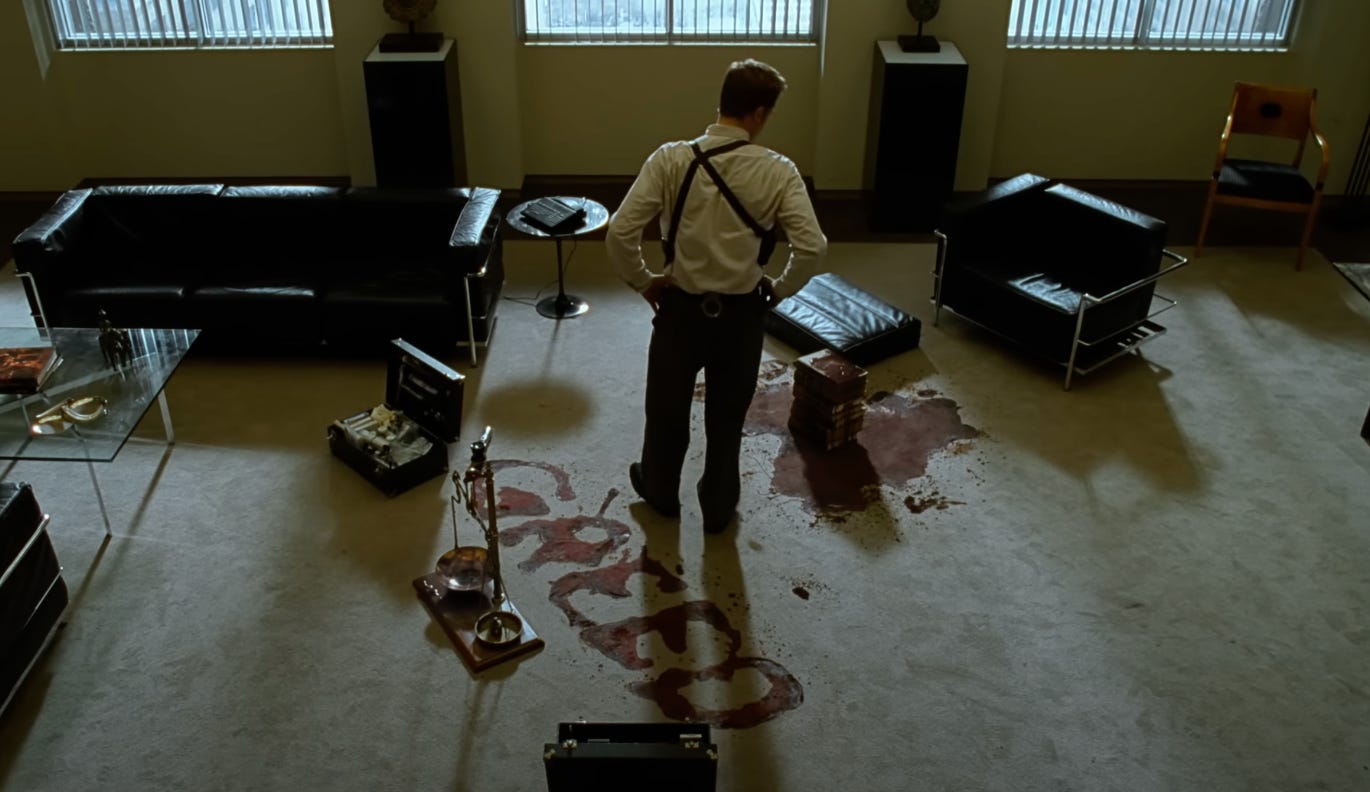
It is not a new observation that Seven (1995, d. David Fincher) is really a film about conceptual art: that the serial killer in the film is some kind of depraved modern artist, that the tortures he devises and the scenes he leaves behind, like those in the Saw films, are triumphs of perverse imagination in the absence of talent.
The best thing about the film is that it knows this: it, too, is a triumph of perverse imagination; I can hardly think of a horror film in which the murders are more horrifying, in spite of the fact that we do not see them take place.
The worst thing about the film—as its director realised when he later undertook to make his perfect TV series Mindhunter—is effectively the same thing. The notion of the serial killer as refined artist—from Camille Paglia to Thomas Harris—is one of the most dismal and dismally untrue clichés in our culture.
It may well be the case, as Adorno once said, that every work of art is an uncommitted crime, but that does not mean that every crime is an uncommitted work of art. Like a crucifix pickled in urine, it might be a conversation-piece, but it will never be more than that.
Brilliantly terse
With “brilliantly” italicised
Amen