
Spartacus
Capsule Film Review #27

This is the twenty-seventh in a series of short pieces (max. 250 words) about films. They appear weekly, in addition to my regular essays.
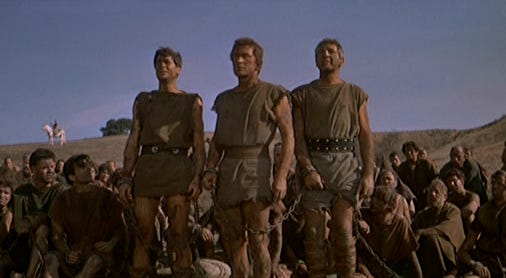
Slaves you were, and slaves you remain: but the terrible penalty of crucifixion has been set aside on the single condition that you identify the body, or the living person, of the slave called Spartacus.
Those are the words delivered to the captured slave-rebels at the end of Spartacus (1960, d. Stanley Kubrick). Everyone knows what happens next, and many of those will know little else about what happens in the film. Sometimes one immortal scene is enough: it is almost strange, considering this one, to think that there are another 195 minutes of things that happen—or to think that even so great a scene is barely a footnote in the career of its director.
Spartacus the film is remembered for that scene, and so, by now, is Spartacus the man. Even the people who know a lot about him don’t know very much, and what most of us know is this one thing: the thing that didn’t happen and yet should have—that last romantic, absurd, beautiful, bloody-minded act of defiance.
Romantic, absurd, beautiful, bloody-minded: delete as applicable. What you see will depend upon you. Marx, who admired Spartacus above all historical figures, would surely have liked it, and seen in it an image of liberation. I did, too, but if I look inside myself I know I saw something else as well, something ugly and cynical…
Fools! All you had to do was point at a corpse on the ground and call it Spartacus.
The ending reads almost as a prose poem. I don’t know why but I’d like to pinch Spartacus and bury him under the cherry trees in full bloom. Beneath the cherry trees, corpses are buried! You may not believe this; instead, I look at them and see the harshness of the beauty, and now, at last, the moment has come when I understand: beneath the cherry trees, corpses are buried. This is something you may believe.
Maybe it's because they knew the Romans would not believe them & maybe they wanted the Romans to see that they were utterly defiant to the end - the way we all should be!