
The Social Network
Capsule Film Review #19

This is the nineteenth in a series of short pieces (max. 250 words) about films. They appear weekly, in addition to my regular essays.
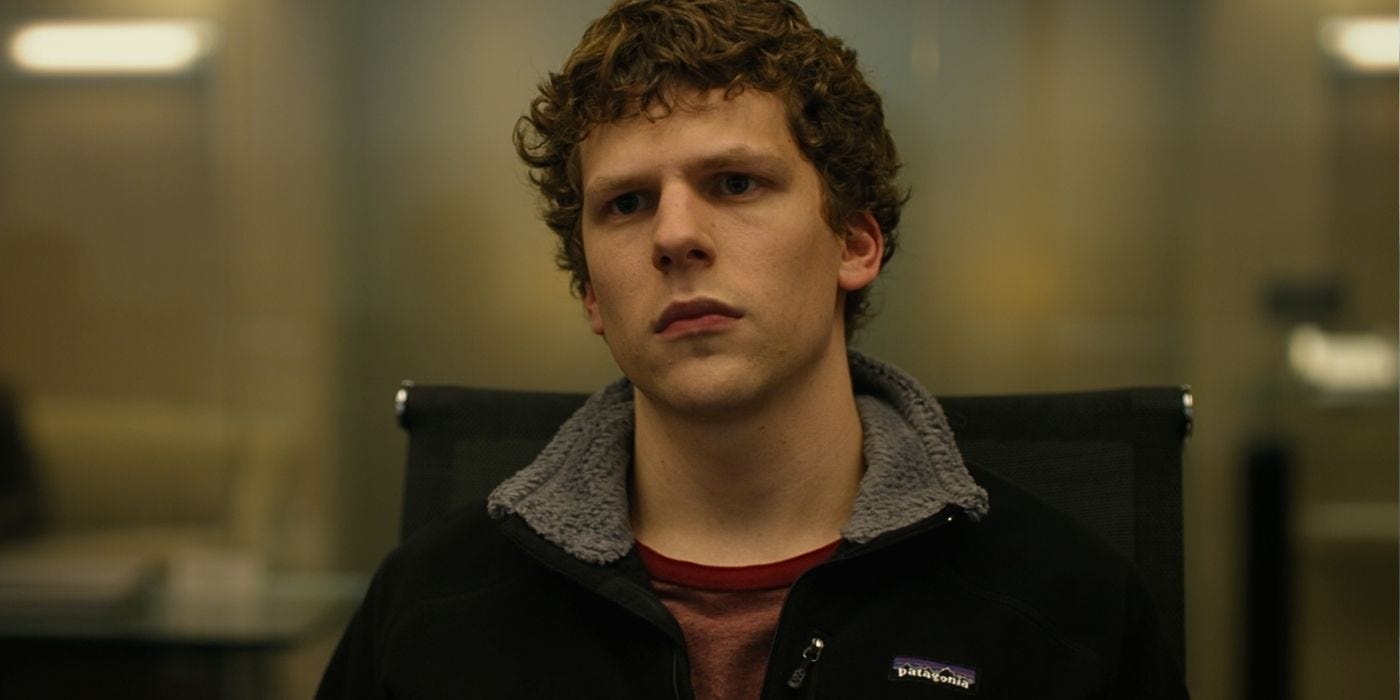
‘The most important person in the motion picture process is the writer,’ said Irving Thalberg, ‘and we must do everything in our power to prevent them from realising it.’ Although, as a typographical affectation, I would normally follow the title of the film here by writing (d. David Fincher), I should really write (w. Aaron Sorkin).
Of course, nobody ever accused Aaron Sorkin of not realising his own importance. Importance is his game: he likes important people saying important things. It was said that the portrait photographer Yousuf Karsh could make even the woman next door look like Queen Elizabeth: Sorkin could make her sound like Abraham Lincoln.
The Social Network (2010, w. Aaron Sorkin) is the story of Mark Zuckerberg and the founding of his terrible platform. In some ways, the film has all of the weaknesses familiar to Sorkin’s admirers: the monologues, the self-plagiarism, the easy put-downs. And yet it works.
Sorkin’s other weakness, rather famously, is his reverent faith in Great Men Making Speeches. This film works (for me anyway) because of his opinion of the great man in question.
Evidently, there can be no doubt that Mark Zuckerberg is a great man. Just as evidently, as with most great men, it would have been better for the human race if he had never been born. We can see this, and so, thankfully, can Sorkin—here, the same folly and evil that he always refused to see in the White House is plain to see.
It is a very good film, and Sorkin is the best of the screenwriters when his subject deals with heavy issues (unlike Studio 60 on the Sunset Strip). He's best when managing dubious characters. Zuckerberg is a brilliant punk who deserves some admiration but further disdain for his mining and selling of protected information likely since day 1 of Facebook's monetization at scale. It is also clear that he stole the idea from those overprivileged twins, which is bad luck for them. They did not have Zuckerberg's vision or will to dominate. Such is life. Perhaps, someday, a future nerdpreneur will name his company Winklevoss in honor of their degradation.
The fact is that the greatest crimes are caused by excess and not by necessity. Men do not become tyrants in order that they may not suffer cold. - Aristotle, Politics