
Three Oddities
On three things which I may or may not understand

1. ‘So you’ve got to the end of our race-course?’
Anyone with the occasional misfortune to read philosophy will recognise the following argument:
Achilles runs ten times faster than the tortoise and gives the animal a headstart of ten metres. Achilles runs those metres, the tortoise one; Achilles runs that metre, the tortoise runs a decimetre; Achilles runs that decimetre, the tortoise runs a centimetre; Achilles runs that centimetre, the tortoise, a millimetre; fleet-footed Achilles, the millimetre, the tortoise, a tenth of a millimetre, and so on to infinity, without the tortoise ever being overtaken…
Movement is impossible (argues Zeno) for the moving object must cover half of the distance in order to reach its destination, and before reaching the half, half of the half, and before half of the half, half of the half of the half, and before…
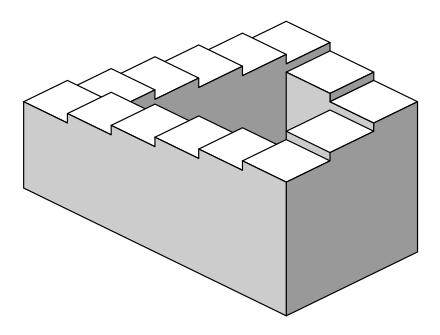
I would like to know if this type of argument—the type that is at the same time unfathomably brilliant and entirely unconvincing to everyone who hears it—has a name. Any number of pages of philosophy, from classic determinism to the ontological argument of St. Anselm, could be categorised alongside it. As Hume said of Berkeley (since subjective idealism lies in the same category), they admit of no refutation and produce no conviction. They share something with the impossible objects of the Penroses and the paintings of Escher, and they are enchanting and terrifying in the same way: for the sense that something has gone wrong, that we cannot tell exactly what, and that we do not therefore know how considerable should be the inferences we make from them.
Most people do not read philosophy, and most of those people will react to Zeno’s paradox with amusement or derision or both—the same way that most people react to poetry, or rather to their own conception of poetry. In Philip Larkin’s critical writing, as indeed in his poetry itself (‘Lozenge of love! Medallion of art!’), there is sometimes an evident hostility towards the notion of poetry—or, rather, of Poetry. Poetry, with a capital P, meant for Larkin something like what poetry in general means to most people anyhow (preciosity, idealism, sentimentality), and for those who share that hostility, reading Larkin for the first time is a relief. But in fact there is no clear difference between poetry and Poetry. Sometimes poets take us with them, and sometimes they don’t: sometimes the diversion fails and we are left feeling the same strange tristesse that comes when we have been laughing for too long and suddenly feel self-conscious. The same thing happens with philosophy: an apparent difference between the discipline capitalised and uncapitalised, and something like hostility towards the former even from some of those (Kierkegaard, Nietzsche, Wittgenstein) most associated with it.
There are moments when philosophy seems very silly, just as poetry does. When George Moore, in Tom Stoppard’s Jumpers, accidentally kills his pet hare while attempting to prove Zeno’s paradox of movement, we laugh; just as I laughed on reading of the young Bertrand Russell wandering through Cambridge one day exclaiming ‘Great God in boots! The ontological argument is sound!’ (Only an intellectual could have come to that conclusion: no ordinary churchgoer ever would.) Yet there are also moments when silliness is exactly what we want from philosophy. What we want, sometimes, from great philosophers, the ones not currently employed by universities, the ones we actually read, are books which are not so much convincing as strange. If you want common sense, call a plumber; what we want from philosophers are castles built on sand, which, fortunately, is what we always get anyway. Auden in his Table Talk called Plato ‘a man of genius who’s always wrong’, and plenty would agree: but the fact that Plato is always wrong (if that is a fact) evidently doesn’t matter, at least not if we judge philosophy the way we should, the way the thinkers of Borges’s Tlön judged metaphysics: ‘as a branch of fantastic literature.’ It is the search for diversion and for consolation rather than for truth. When one of the other George Moores, the real philosopher, held up both his hands in order to disprove Berkeley, he resembled no one so much as a man standing in a theatre in Act 5 of King Lear to inform everyone else that the dead Cordelia is, in fact, a living actress.
Kick at the rock, Sam Johnson, break your bones:
But cloudy, cloudy is the stuff of stones.
— Richard Wilbur, ‘Epistemology’
2. ‘Even when I’m wrong, I’m right.’
I would also like to know the relationship, if there is one, between these arguments in philosophy, those which are spontaneously unconvincing but on closer inspection impossible to answer, and some of the sentences described by linguists which seem somehow opposite, spontaneously convincing (i.e. apparently ordinary and comprehensible) but on closer inspection meaningless. There are many versions of the following sentence, for instance, the so-called ‘comparative illusion’:
More people have written about this than I have.
Try slipping it into a conversation, the linguist Geoffrey Pullum suggests: would anyone notice how bizarre it is? Pullum’s colleague Mark Liberman actually calls these Escher sentences, and understandably: surely any English speaker, in the middle of a busy conversation, would think at first that they understood it; and surely any English speaker, given a matter of seconds to think about it, would see something wrong; and yet no linguist has been able to explain exactly why this is so. It is, in its own way, terrifying, just like Zeno’s paradox of movement and the Penrose stairs: it seems to threaten us with the thought that all our knowledge is invented, that all our systems are bogus.
Erving Goffman wrote that we have two main ways of dealing with stigma: we can conceal whatever it is that stigmatises us, or we can embrace it and assume it into our public personas: a schoolboy who feels stigmatised for being gay, for example, can either butch it up or camp it up. And these seem to be the two principal ways of dealing with this particular terror, the spectre of meaninglessness that comes both with Zeno and the comparative illusion: you can double down or you can opt out. Both are endemic to our age.
Opting out would be apathy, turning away from the world by denying that any of it is meaningful. The fact that we can hardly know anything is an excellent excuse for knowing nothing; the fact that a given philosophy is built on straw relieves me of its search for meaning, and of the obligation to study it systematically; if nothing matters, then neither do my failures and my mistakes.
The opposite, doubling down, would be something like ideology, an attempt to impose patterns on the world, to dress it up like James Stewart dresses up Kim Novak in Vertigo: because he wants to be fooled. Doubling down, human history itself has become a work of art, not stupid and senseless as history actually is, but somehow complete.
An extreme version of doubling down is that of the conspiracy theorist, who in identifying patterns and connections and intentions everywhere in the world tries to assert control over it. The twenty twenties are, as everybody knows, a golden age for conspiracies, harmful or otherwise: never in human history has so much misinformation spread to so many so easily.
I learnt from Last Week Tonight with John Oliver that an American conspiracy theorist, a presenter on a far-right news network, uses the extraordinary slogan: ‘Even when I’m wrong, I’m right.’ Of the truly far-gone conspiracy theorists—the Trumps, the Ickes, the Alex Joneses—it would be truer to say that even when they’re right, they’re wrong. Without the Treaty of Versailles, and their rhetoric exploiting it, the Nazis might never have come to power in Germany. When Hitler said that that treaty was unjust, and punitive, and organised by elites without regard for ordinary Germans, he was perhaps saying something true, but the truth was surrounded by so much poison and nonsense that it didn’t much matter. When the White Working Man—by now a sainted stock character—says that life was better in the fifties, there is some truth to that as well: things were better for them back when America taxed the rich at ninety per cent, when you could be a Fifties Man—with a house, a car, and a family—with no education and a truckdriver’s salary. Looking at how the America of the nineteen fifties became the America of the twenty twenties, some of us see the destruction of social democracy—which is exactly what we want to see. And we would hope that we would be willing to change our minds if somebody gave us good reason: remove that hope and that willingness and you get a modern-day conspiracy theorist.
If we lean towards opting out rather than doubling down, that is—like all philosophy—a matter of temperament. Understanding everything is a kind of control, but there is an infinite liberation in understanding nothing. It is, like every other kind of infinite liberation, unattainable, and yet—again, as with every other kind of infinite liberation—we seek it all the same. It is like deciding not to care, another kind of longed-for liberation which never works. Those who make that particular resolution all end up like Mickey Sabbath in Philip Roth’s great novel:
If he no longer gave a shit, why did he give a shit?
What would it mean, anyway, to truly know that it’s all meaningless? And what would it mean for our desire for understanding to be sufficed? As it is, we always seem to understand just enough to suggest that it might be worth continuing, that some greater understanding is almost within reach. But we have no desire to know everything—not really. Feuerbach said that that desire, like the desire for eternal life, is imaginary.
Nothing is easier than to know that somebody else is under a delusion. Common sense would tell us that, by definition, we can’t know the delusions that we are under. And yet every day I feel there are moments in which I recognise that I’m kidding myself with almost everything that I do.
3. ‘How many languages do you speak?’
I tried to describe two kinds of oddity above, neither of which I can begin to understand. But staring out of the window as I do most days I find that the sentences which trouble me most are not philosophical paradoxes or linguistic illusions but much more banal, much more quotidian examples. I don’t know if these sentences are, on sober reflection, as simple as they appear or if they are, on sober reflection, very complicated, mostly since I don’t know if ever give sober reflection to anything.
I wrote a few of them down:
Only boring people get bored.
What a waste of time!
You can’t change the past.
You’re born alone and you die alone.
You can’t make an omelette without breaking some eggs.
And so on.
I can give any amount of complication to the phrases above and it makes no difference. I know—which is to say I’m convinced by the argument that—only boring people get bored, that with every ‘boring’ situation or book or person comes some interesting reflection or knowledge that can be extracted. And yet I am heavy bored. I know that no time is wasted, or at least that, without having a clear idea of what the opposite would be, the concept of wasted time is incomprehensible—and yet no amount of reasoning will convince me that I have not wasted my life. I know that I cannot change the past, that everything I have ever done or that has ever been done to me will have been done for eternity—and yet I am writing these words.
I started doing so after I was asked the following harmless question, with a readily apparent meaning which seemed, on reflection, bafflingly, absurdly vague.
How many languages do you speak?
That’s it. And there is no part of it that I can’t complicate.
Languages? And who knows what a language is? In Italy, where I live, there are people who will tell you that the languages of their people—not the Italian language, but the regional languages—are dialects of the state language. Some Sardinians, who may not speak any form of Sardinian, will tell you that Sardinian is a dialect of Italian, which it is not: you can speak Italian perfectly well without understanding a word of Sardinian, which is in its vocabulary and grammar and history as separate and distinct from the national language as Swedish is from German (or perhaps more so; I don’t know). And it isn’t just in Sardinia: everywhere I’ve been in Italy the same assumption seems to reign. In Veneto I knew people who spoke Venetian (which Italians actually call dialetto veneto), but I never met anyone who would answer the question ‘How many languages do you speak?’ by saying Italian and Venetian. But Venetian is another language—though even if some of my friends might have admitted that, they would still find a way to dismiss it by calling it a language of peasants, or of the uneducated, or perhaps regular Italian with mistakes in it, as though an entire language could somehow be inferior to another.
There is an old Yiddish saying that a language is a dialect with an army and a navy. Neither Sardinia nor Veneto are independent nations, and so their languages are dialects. Sweden, Denmark, and Norway are independent, and so their languages are languages, even though—as is not the case with Sardinian and Venetian and Italian—Swedish, Danish, and Norwegian are (I am told) mutually comprehensible for the most part. Scots ‘dialect’, the language of Robert Burns, is pretty well comprehensible for an English speaker when written down, but not when spoken; the language of Chaucer is not comprehensible at all for the uninitiated; and nor, for that matter, are parts of Shakespeare. So if I can read Shakespeare and Chaucer and Burns, how many languages do I speak?
But think of the word speak, too. I teach English to Italians for a living, and when the subject of learning languages comes up in class I always ask: ‘What languages do you speak, apart from Italian and English?’ In almost every case, whether the students are near-beginners or near-fluent, they react as though I’m being too complimentary. They speak Italian, and they are learning English, but they don’t speak it. And I tell them, of course, that if they understood the question then they surely must, in some sense, speak English.
Inside the classroom, people are more likely to recognise that their English needs work—if they didn’t, after all, why would they need lessons? Outside the classroom, the people most likely to state with total confidence that they speak English are those whose English is very poor: the kind of waiter or shop assistant who, the second they hear a foreign accent coming out of your mouth, will refuse thereafter to speak Italian with you. (The Catch-22 for native English speakers abroad is that certain people will only speak their native language with you if your command of it is already so good that you don’t need the practice.) But even a basic ability to communicate basic things, which those people have, could be characterised as speaking a language. Conversely, a very advanced competence in a language, in certain contexts, might not count as speaking it. If I were ever to attempt to write poetry in Italian I would quickly come to the conclusion that I do not in fact speak Italian—as would any Italians who read me. Occasionally, in the course of being an English teacher, you encounter students who are so massively confident as to attempt to produce literature in English—and I haven’t seen any good results yet. A friend of mine had an elementary-level student (i.e. a student who lacked even a practical competence in everyday English) who wrote, or believes he wrote, an entire novel in English, which might well one day be considered some kind of outsider-art masterpiece. When my friend showed me a few passages from this novel it wasn’t long before we both fell about laughing, alternating between guilt (since it’s difficult to learn a language, and everyone has to start somewhere, and without a doubt we sound silly in Italian, and it’s not nice to laugh) and a kind of self-righteous disdain for the author’s complete lack of awareness of what he does not know. Here, chosen literally at random, is a paragraph from this text:
The houses are distant 50 meters apart, the green appliances are neighbors, so the young people, who love wolking in the nearby woodland meet often: Paul, exuberant and extroverted, in the presence of Vivien, he conceals his inner and interior transport. He’s an handsome, and brilliant man, refined tastes and he can show off an elegant bearing. His sense of humor allows him to face the embarrassing situations linked to possible disruptions.
Does the author of that passage speak English?
Complicating the matter further is the word do: ‘How many languages do you speak?’ There is a question then about languages we knew in the past but have now forgotten: when I left school I could speak enough French to have a conversation or pass an exam, but now I could hardly ask directions to a bakery, let alone follow them. But to say, in answer to the question, that I did speak French ten years ago seems wishful—but what if I say that I did speak Italian yesterday, or this morning, or five minutes ago, even if I am not doing so in this moment and doubt myself? When I used to drink, and would wake up with so much alcohol in my blood that entire days or weeks would disappear, there were certainly times when I found I would completely lose the ability, or maybe the desire, to speak Italian, when the words in my brain could not find their way out of my mouth.
Who knows?—or, as I should not say, chissà? Qui sait? Habitually I compare competence in speaking any foreign language with competence in speaking my own. I think of speaking another language, according to the jargon, as unconscious competence—but what, in the end, does that mean? From a psychology textbook:
The individual has had so much practice with a skill that it has become ‘second nature’ and can be performed easily. As a result, the skill can be performed while executing another task. The individual may be able to teach it to others, depending upon how and when it was learned.
Certainly speaking English is second nature for me, certainly I can perform it easily, and certainly I can perform it while executing another task. (Would it depend on the other task? I don’t think so. I might physically be unable to speak underwater, but I wouldn’t have forgotten how.) And what does it mean to perform speaking English? And what does second nature mean?—and so on, and so on, and so on.
We all know that Achilles would beat the tortoise, just as we know that we occasionally decide to raise our right hand rather than our left. We also all know that ‘More people have written about this than I have’ signifies something like ‘There are other people in the world more knowledgeable than I am’. And I know what ‘How many languages do you speak?’ means, and all these words and all these reasons mean nothing, since I cannot silence the voice inside me that hollers an answer in my ear, the answer that is, in some way, the one I want to believe. How many languages do you speak? One.
https://substack.com/@graywyvern/p-70317099