
My Dinner with André
Capsule Film Review #37

This is the thirty-seventh in a series of short pieces (max. 250 words) about films. They appear weekly, in addition to my regular essays.
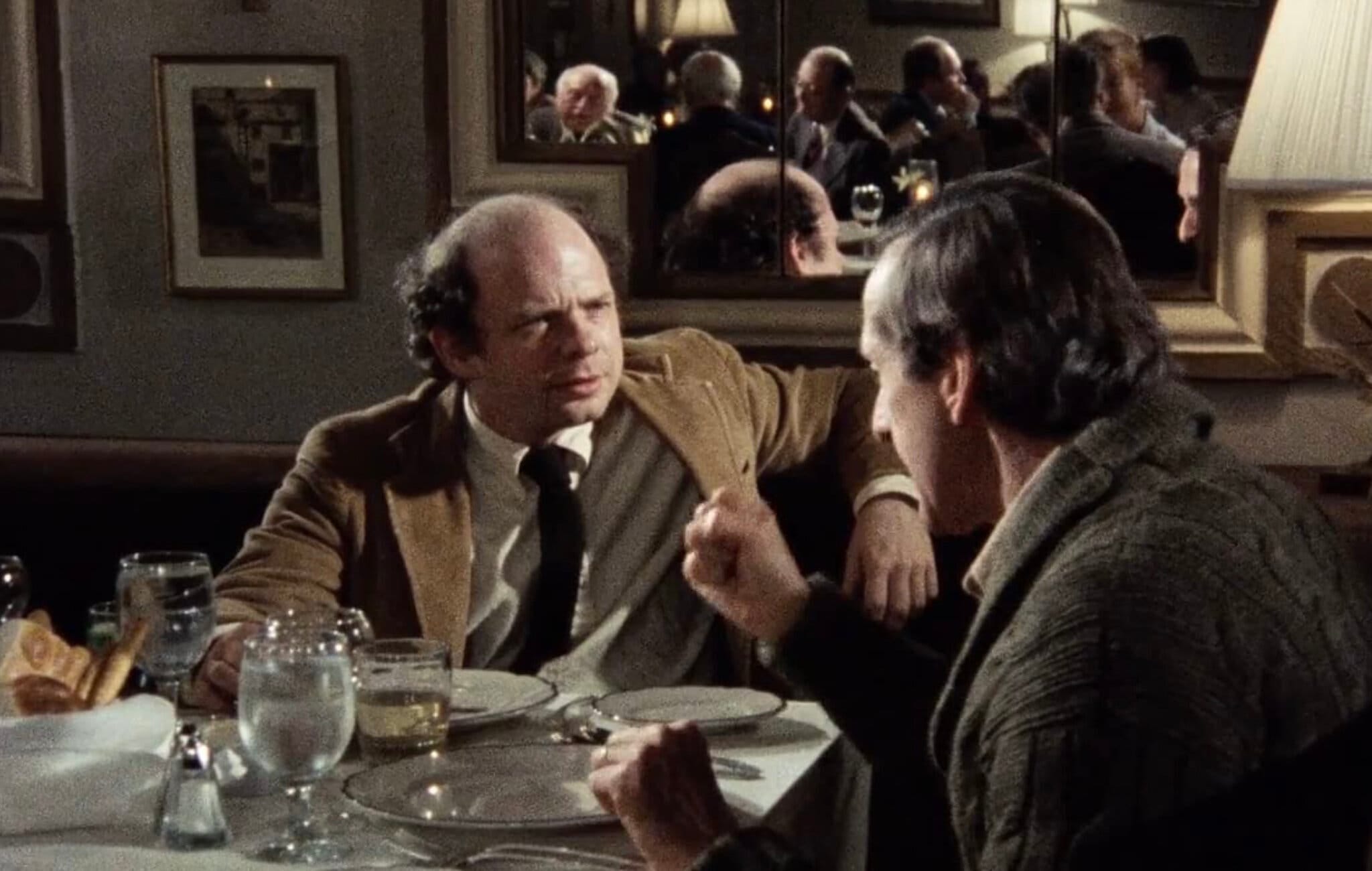
‘Talking isn’t cinematic’—that, at any rate, is one of the often-repeated film dogmas. The cinema is a language of images, not words; text-based cinema is a contradiction in terms; actual language is an irrelevance.
Exactly why anyone should believe this even for a second is unclear to me. Words, as Orson Welles once bluntly put it, are terribly important in talking pictures: they were for him, and they are for us; bad words can ruin a film. The fact that you can have cinema without words, as was the case during the silent era, is beside the point: you can have cinema without colour as well, but no one would say that colour is therefore not cinematic.
Perhaps it is only the cult of the director that has caused people to promote such a strange idea. He—and for said cultists it is usually a ‘he’—can be the ‘author’ of the film even if somebody else writes everything that happens in that film.
This is not to say that My Dinner with André (1981), a masterpiece continually being rediscovered, proof positive of the existence of text-based cinema, is not Louis Malle’s film, but simply that it is not only—not even primarily—his. It is also Wallace Shawn’s and André Gregory’s. When the evidence contradicts the theory, you throw out the theory, not the evidence. In the movies, however, as in the rest of life, there will always be some who contrive to do otherwise.
A favorite film that has never been distributed in Japan… I love it (and André Gregory autobiography is a fun read… )
I used to see Wallace Shawn in a restaurant in New York, eating alone. Never had the idea to say, may I dine with you? Drat.