
Last Summers
On Keith Douglas's 'Canoe', romantic love - and tech

I have written about particular poets before in essays on Samuel Menashe, R. S. Thomas, Stevie Smith, Philip Larkin, Les Murray, and Anthony Hecht.
Thank you to Huck for his comments on the second part of this piece.
Canoe by Keith DouglasWell, I am thinking this may be my last summer, but cannot lose even a part of pleasure in the old-fashioned art of idleness. I cannot stand aghastat whatever doom hovers in the background: while grass and buildings and the somnolent river, who know they are allowed to last forever, exchange between them the whole subdued soundof this hot time. What sudden fearful fate can deter my shade wandering next year from a return? Whistle and I will hear and come again another evening, when this boattravels with you alone toward Iffley: as you lie looking up for thunder again, this cool touch does not betoken rain; it is my spirit that kisses your mouth lightly.
About Douglas
One of the most romantic poems in the English language, Keith Douglas’s ‘Canoe’ is—as perhaps could be said for all romantic love, and most everything ever written about romantic love, from La Vita Nuova to De Profundis, from Shakespeare’s sonnets to Pablo Neruda—at the same time tiny and gigantic. It is both of these things to such an extent, in fact, that I can never quite decide, when I recite it, whether there is too much to say or whether there is nothing to say. A great deal of criticism written about poetry exists in that strange space.
Tiny and gigantic: in a literal sense, to begin with, it is clearly only the former. Four quatrains and sixteen lines, amounting to four sentences, 119 words, and 546 characters: less than the length of two Tweets, and probably quick enough (even my slow reading of it above is only about eighty seconds) to be recited in a TikTok video.
Its technical effects—as I hear it, at least—make it seem smaller still. Those imperfect rhymes, withholding satisfaction as they do, contribute to that effect, the eerie sense of anticlimax enhanced somehow by where they have been placed. ‘Iffley’ and ‘lightly’—which end with the same unstressed syllable, and which therefore rhyme both too much and not enough—come at the end, where a firm conclusion might have been. ‘River’ and ‘ever’, which only half-rhyme, are on the other hand placed side by side, begging for an easy resolution that doesn’t quite come. Even some of the full rhymes, indeed, share that bathos, and so seem small in their own way too: the rhyme ‘background’ and ‘sound’, for example, also withholds satisfaction, since ‘-ground’ is unstressed; as perhaps, depending on how you pronounce the first word, does the rhyme of ‘again’ and ‘rain’.1
Metrically, too, something similar holds, or seems to: making due allowances for the personal nature of scanning a poem—more personal, perhaps, than we like to admit—I would say that iambs just about predominate here, though that is probably only because they predominate in the spoken language: really, there are so many substitutions and variations that it seems inadvisable to put this poem in a neat metrical box.
And yet, it is a metrical poem, evidently; though often vernacular, it is not remotely prosaic. You could, again, write it out as two Tweets if you wished, but it would not read as prose if you did. Equally, though you could, if you wished, try to paraphrase it, you could never do so satisfactorily, though this may be another way saying that it is, in fact, a poem.
An unsatisfactory paraphrasing would be something like this:
I am going away, and it may be that I won’t come back. Yet I’m living this moment now, here on this boat on this river with you now, doing nothing in particular, and that is enough. For, in another sense, I will come back, even if my body doesn’t, because I will come back to you.
That is the literal sense, and there’s nothing very complicated in it, at least as I have expressed it here. And yet the literal sense does not take us far. Only the first five lines of the poem—the ‘last summer’, ‘the old-fashioned art / of idleness’, the ‘doom’—really ask to be taken literally; and they would ask as much, perhaps, even without a context.
We have a context, however. The date beneath the poem alone—1940—would give us a clear enough idea of what the ‘doom’ in question was; and even the small knowledge I have of the poet’s life and works gives a clearer one.
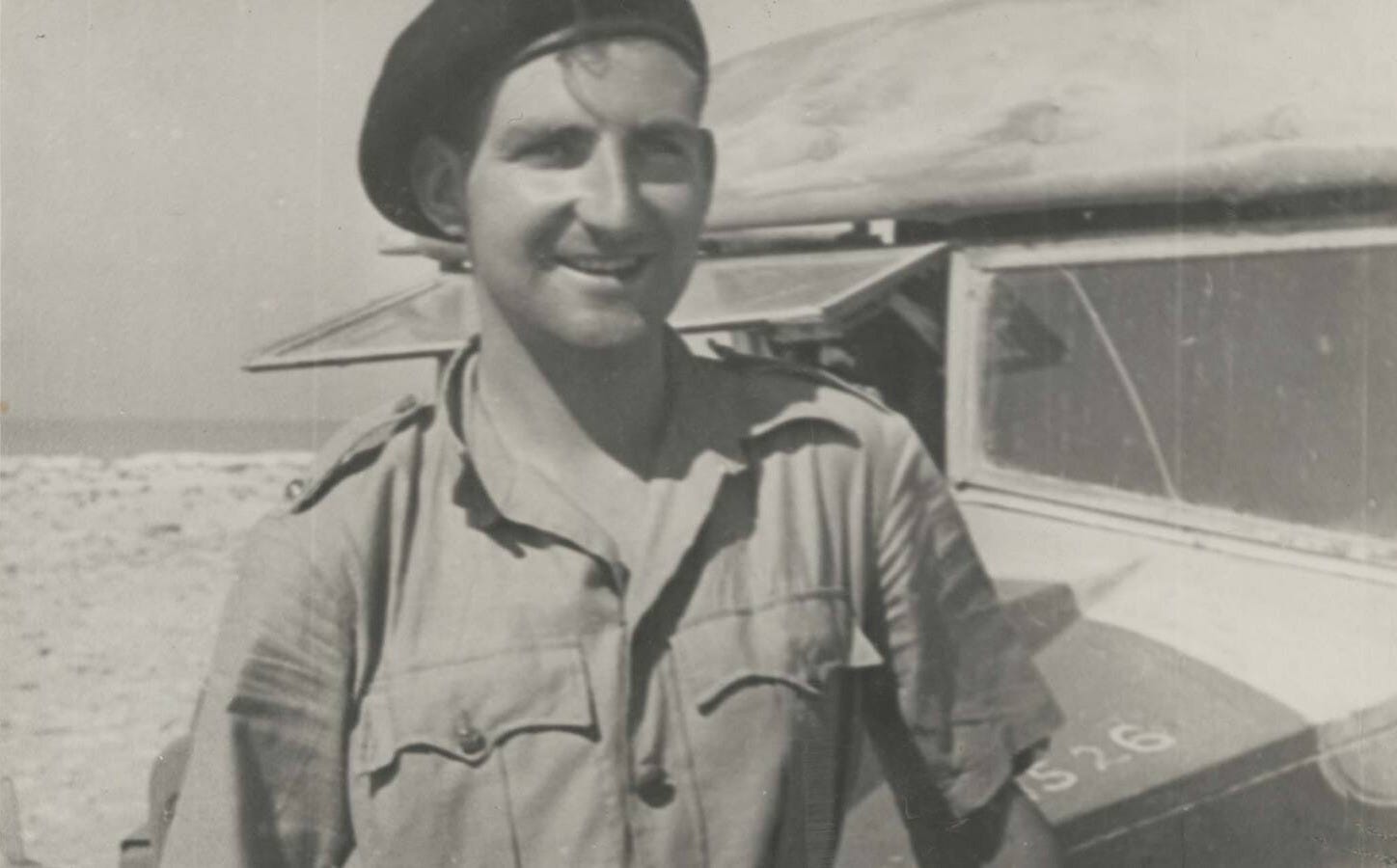
Born in Kent in 1920, Douglas was the son of an English army captain and failed businessman, also called Keith, and his wife, Marie Josephine Castellain. The family was middle-class: notwithstanding financial straits, Douglas attended public schools (i.e. private schools) in England, partly on scholarships or bursaries, before winning an open exhibition to study at Oxford, where ‘Canoe’ is set. By the time he wrote it, in the summer of 1940, he was twenty years old and, though that summer was not in fact his last, he was indeed about to go to his doom. He began his basic training in July of that year, was subsequently posted in the Middle East and North Africa for much of the war, and was killed by a German mortar in Normandy on 9th June 1944.
By the time of his death, he had written a memoir, Alamein to Zem Zem, and enough poems to fill a short volume: the Faber edition of his Complete Poems runs to about 200 pages. As was the case with Wilfred Owen, Douglas’s opposite number in the previous world war, many of the early poems were forgettable; as with Owen, that doesn’t matter much: for the poems that made him famous were the half dozen or so masterpieces that came out of his war, poems which, for the most part, were about dead men, like the heartbreaking ‘Vergissmeinicht’:
Look. Here in the gunpit spoil
the dishonoured picture of his girl
who has put: Steffi. Vergissmeinicht.
in a copybook gothic script.2
If Randall Jarrell was right, and a good poet need only be struck by lightning five or six times in a writing life, then Douglas is a good poet beyond question; for what it’s worth, I want to call him a great one, like Owen.
Most of his famous war poems, like ‘Canoe’, are short; and yet none of them, I think, is tiny in the way that ‘Canoe’ is tiny. Equally, though they are all gigantic in their way, none of them is gigantic in the way that ‘Canoe’ is gigantic.
Death, in those poems, is not a presence hovering obscurely and half-ignored ‘in the background’: on the contrary, it is ever-present; in them, Death is everything and yet nothing, an infinite vacancy, a shadow. At the same time, the dead themselves are shadows, though they are not eternally wandering, as in ‘Canoe’.
They are men like Douglas himself in ‘Simplify Me When I’m Dead’:
As the processes of earth
strip off the colour of the skin:
take the brown hair and blue eyeand leave me simpler than at birth…
They are men like the dead Peter in ‘Aristocrats’:
Peter was unfortunately killed by an 88:
it took his leg away, he died in the ambulance.
I saw him crawling on the sand, he said
It’s most unfair, they’ve shot my foot off
Or they are men like the unnamed dead soldier in ‘How to Kill’:
and with how like, how infinite
a lightness, man and shadow meet.
They fuse. A shadow is a man
when the mosquito death approaches.
‘Canoe’ is not like that: in ‘Canoe’, death hovers in the background, as it must, but love sings in the foreground. Though the speaker, unlike the natural world, is not ‘allowed to last forever’, no ‘sudden fearful fate’, he suggests, can stop his shade returning; as long as the memory of love goes on, he will go on, too; here, love is more powerful than death.
It is that fleeting thought, obviously, that makes the poem so exquisitely romantic; it is also the main thing that makes it big and small. Love is more powerful than death: we believe that, perhaps, only for small moments; at the same time, if you have not believed that even for a small moment, then you have probably never been in love; in the moments when we do believe it, we believe it more strongly than anything.
Love is more powerful than death: it seems to me that it would be difficult for a poet to say something like that today.
About us
How would people respond if you tried saying all this now, or if you tried to write a poem like this one? Throw out a poem with sentiments like this online or send it to a magazine, and I wonder what would be the response (if there was a response) from Serious Poetry People.
It is easy to think, given both what the poem says and the rather straightforward way in which it says it, that you might, from some quarters, hear something like knowingness. Isn’t this sort of lyricism and feeling and indeed poeticism, after all, unattainable to us today? How sentimental to believe, even fleetingly, in romantic love. And how privileged as well to be on a canoe in Oxford while ‘doom hovers in the background’. And how clichéd, how very clichéd, in the end, to imagine my own ghost kissing your mouth lightly…
Well, I am thinking I have in fact heard all three of those responses to this poem (though, admittedly, all from the same person). What can you say?
First of all, perhaps, that knowingness is the great intellectual sickness of my generation and of the tech that, against our collective will, has shaped it. Our knowingness is really just fear, like our famous insincerity; it has no more to do with real knowledge that that insincerity has to do with real irony. Fear: we are a generation that is afraid to express anything; that criticises because it cannot create or, rather, because it has been beaten into thinking that it cannot create; convinced that it can only roll its eyes even at the opinions I am writing in this very moment. Sentimental, privileged, clichéd…
Douglas’s ‘spirit’, though, is not a cliché: the spirit kissing ‘your mouth lightly’ is elemental, like the river of time, and a privileged life—and we should remind ourselves that anyone can be characterised as having a privileged life, depending on whom you compare them to—is still a life. Furthermore, the fact that some would call the sweet dreams of romantic love sentimental is only a sign that we can no longer distinguish between sentimentality and sentiment—one reason that so much published poetry today is so very feeble.
The un-literal nature of everything that follows the first five lines of ‘Canoe’ is, it seems to me, testimony to this. I was here; I felt this; do you deny it? And it simply doesn’t matter, in this poem, whether the poet believes his shade will really return or not, for the same reason that it does not matter that rivers cannot really be ‘somnolent’; that rivers and grass and buildings do not really ‘know’ anything at all; that no period of history really has a temperature or a ‘subdued sound’; that you cannot really look at thunder; or that dead people cannot really kiss the living.
We know this, though we have forgotten. I am going to die, but in you, my love, I live: calling such a sentiment a cliché is a nonsense, just as it is a nonsense to call it an illusion. All that would amount to is saying that the sentiment does not last, which is doubtless true: but that doesn’t make it an illusion, let alone an unfit subject for a poem, any more than a hangover makes the night’s drunkenness an illusion.
Love, like drunkenness, is a feeling; poetry is in the business of putting words to feelings. Real sentimentality in art is fake feeling; the feelings that you actually have are not; if you feel a feeling, then it is not an illusion; and expressions of feelings like this are as open to the poets of 2026 as they were to the poets of 1940, or indeed of 1540.
I’m starting to feel I’m protesting too much.
About me
‘Well, I am thinking this may be my last / summer…’ Strange to think that, since I first read the poem when I myself was twenty years old, I have said those words at the beginning of summer every year, and every year I have meant them, wherever or not I have had anyone beside me on that boat. Every year, including and especially this one: I suppose that this may be my last…
I was pleased, albeit a little alarmed, to have been characterised by one of my readers as the Essayist of Shame.3 There is, I guess, some small shame in the back of my mind at the fact that I identify with a poem like this, from my still point in the first world in 2026. I am not going to go to war, after all; though my health is bad and my finances are worse, I do not have a fatal illness, and I do have access to free healthcare; I am, statistically speaking, unlikely to die this year.
Doom, on the other hand, is hovering in the background, for me as for everyone else. What Eric Hobsbawm called ‘the expectation of apocalypse’ is a constant presence in my life and, I presume, whether you are of my generation or not, in yours. To some extent at least, I probably have that in common with the young men and women of 1940: there were people, we remember, who had started to predict the Second World War before the first one had finished.
It could be instructive, at this point, to again compare Keith Douglas with Wilfred Owen. Every literate English speaker, whether they read poetry or not, knows about the poets of the First World War, and not just Owen but Siegfried Sassoon and Isaac Rosenberg and the rest of them, in the same way as we know, or think that we know, about that other world from which they sprang. Even a poet as stubbornly undeluded as Philip Larkin saw, or thought that he saw, an innocence in that other world, an innocence never to return.
Yet there is no comparable cultural knowledge of the English poets of the Second World War. ‘What was noticeably lacking in 1939,’ wrote one critic about Douglas’s poetry, ‘was shock.’4 There were shocks to come—the existential and moral crisis that came from the Holocaust and the Gulag. But the real shock of the time, however, the collapse of civilisation and liberal order in Germany was, for a young man like Douglas, altogether elsewhere, like the Ukraine, in that place that the British refer to as ‘the continent’.
Douglas’s generation in England were not shocked by their war. In ‘Canoe’, he knows perfectly well that the tranquillity of Oxford and the river is in a sense a small haven from the real world: his boat is ‘drifting onward dreamily’ just like Lewis Carroll’s at the end of Through the Looking-Glass; unlike Carroll, he cannot quite slip into the Dream; he ‘cannot stand aghast’ at the doom, but the doom is there, all the same.
It is apt, in this regard, that so much of the imagery of the poem—the fate and the boat and the ‘shade wandering’—seem to call up a Hellenic underworld; since that underworld in turns calls up the world of classical education, which is to say the protected world of the English middle-classes: the public school system, the universities, the garden cities, and the City itself.
That was the world I was born into, and I’m not convinced, if it still exists, that it will exist for much longer. And, anyway, if it is still there—can it really be a haven now? Those who are not too far gone in knowingness may well be able to believe, even now, that love is more powerful than death: the idea that love is more powerful than tech seems almost impossible to believe.
Clichés, again? Very well, clichés again. Think of those two young people, practically teenagers, today, on their canoe: would they be livestreaming their trip, or posting on Instagram photos of the buildings and ‘the somnolent river’, or asking ChatGPT to write a poem for them about the experience? If Keith and his love were sailing down that river now, they would surely both be holding smartphones, and they would be holding them because they had been addicted to them, deliberately. Furthermore, that’s a bad thing. To say so is so titanically obvious that some people are even able to convince ourselves, every now and again, that it isn’t true. But it is true, and that, too, is the other reason that I recite ‘Canoe’ to myself… not only in those moments when I am in love or feel that I don’t have long to live, but in those moments when I would like to hold on to ‘the old-fashioned art / of idleness’.
Everything by now, in 2026, is against that art. We work and wonder what we’re working for: survival, I suppose, though what survival might mean in a world so hideous is anyone’s guess. How can I be idle, or enjoy idleness, even in those moments when I don’t have to work? Shouldn’t I be out doing something productive: on the streets protesting the strongmen, perhaps, or maximising my altruism, or working on my brand, or learning how to use AI to Start My Business Today?
All of the tech that dominates our lives is against idleness, really. To be idle is to be lazy without wasting your time: but unless you have realised that, pissing your life away on a smartphone might seem like being idle. But it isn’t: idleness is the opposite of social media. Idleness is still; it is contemplative; what you get from social media—including, more and more, this very platform—is pointless activity, and the dominant ideology of the age is Zuckerberg’s ideology: the ideology of connectedness and identity and efficiency.
Douglas did not have to deal with that ideology, and, though his generation was undoubtedly worse off than mine, he was lucky in at least that regard. The other thing, apart from shock, that his lot lacked when compared to Owen’s was the sense of futility: there was no shock for them at the outbreak of the Second World War, but there was a sense that there was something worth fighting for. Now, we do not have the shock, but we do have the futility. It’s hard to imagine, as long as I am trapped in my devices, that this situation will ever change, that my shade will ever be able to wander…
Well, I am thinking this may be my last summer. Nothing like starting it off jealous of a dead soldier.
In my reading, I decided on making it into a half-rhyme, though I’m far from sure that this is what Douglas intended.
Vergissmeinicht means forget-me-not.
funnily enough I used to live on Iffley Rd...
Douglas was a great poet and this is a great piece! I used to teach Vergissmeinicht as part of course on "War Poetry" but took it out because it made me cry in front of the students.